
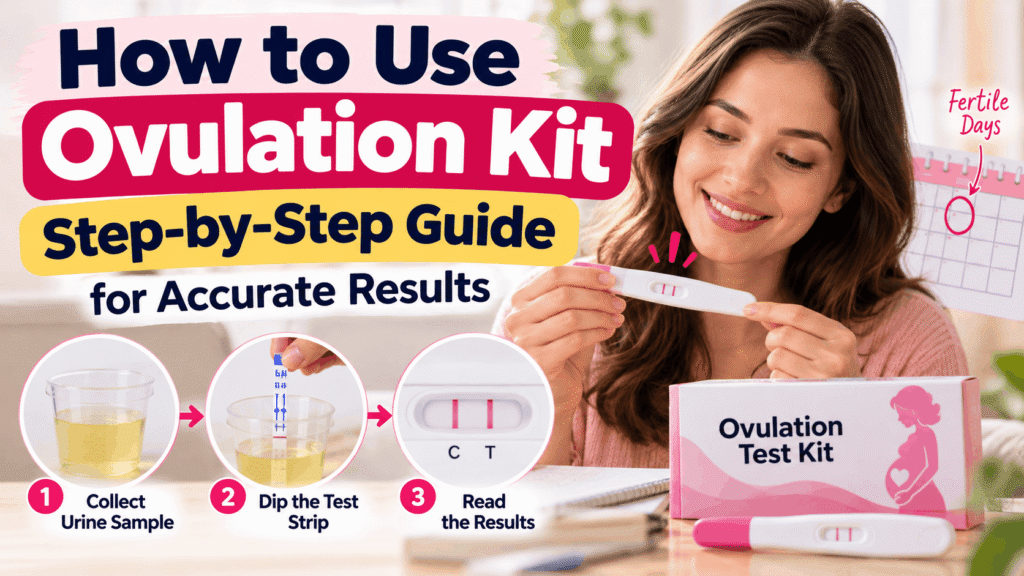
If you are wondering how to use ovulation kit tests the right way, the answer is simple. You collect a urine sample at the same time each day, dip or hold the test as the pack says, wait a few minutes, and read the result. A dark test line that matches or beats the control line means your LH surge has started, and ovulation is likely close.
Sounds easy, but small mistakes can give confusing results. Testing too early, drinking too much water, or reading the strip late can all change what you see.
This guide walks you through every step in plain words. You will learn when to start, what the lines mean, and what to do next. You will also find common mistakes, a comparison of kit types, and clear advice on when to talk to a doctor.
Note: This article is for education only. It does not replace advice from your doctor or midwife.
What Is an Ovulation Kit and How Does It Work?
An ovulation kit, also called an ovulation predictor kit (OPK) or LH test, checks your urine for luteinizing hormone (LH). LH is a hormone made by your brain. It stays low for most of your cycle.
About one to two days before ovulation, LH rises sharply. This jump is called the LH surge. The surge tells your ovary to release a mature egg. An ovulation kit spots this jump so you can plan sex or insemination at the best time.
What Does an Ovulation Test Actually Tell You?
A positive result means your body is getting ready to ovulate. It does not prove that an egg was released. It also does not confirm pregnancy. Think of it as a heads-up, not a guarantee.
Quick answer (Featured Snippet): An ovulation kit measures luteinizing hormone (LH) in your urine. When LH rises sharply, the test line turns dark. This LH surge usually happens 24 to 36 hours before ovulation, which helps you find your most fertile days.
Why Timing Matters When Trying to Conceive
An egg lives for about 12 to 24 hours after release. Sperm can live inside the body for up to five days. Because of this, your fertile window is about six days long. It ends on the day of ovulation.
The two or three days right before ovulation are usually the best chance to get pregnant. An ovulation test helps you spot those days.
🌸 Free Ovulation Calculator: Find Your Test Start Date
Not sure which day to begin testing? Enter your last period date and cycle length in our free Ovulation Calculator to see your estimated ovulation date and fertile window in seconds.
💗 Use Free Ovulation CalculatorEstimates only. Not a substitute for medical advice.
Types of Ovulation Kits (Comparison Table)
Not all kits look the same. Some use simple lines. Others use a digital screen. Here is a quick comparison.
| Feature | Strip Tests (Line Tests) | Midstream Tests | Digital Tests | Advanced Digital Tests |
|---|---|---|---|---|
| What it measures | LH | LH | LH | LH and estrogen |
| How you read it | Compare two lines | Compare two lines | Smiley face or symbol | Low, high, or peak fertility |
| Cost | Lowest | Low to medium | Medium to high | Highest |
| Ease of reading | Needs practice | Needs practice | Very easy | Very easy |
| Fertile days shown | Usually 1 to 2 | Usually 1 to 2 | Usually 1 to 2 | Often 4 to 5 |
| Best for | Budget testing, daily tracking | Easy use without a cup | Beginners who want clear answers | Irregular timing or extra guidance |
Which Ovulation Kit Should You Choose?
If you are new to testing, a digital kit can feel less stressful. If you want to test often and save money, strip tests work well. Many people use cheap strips for daily testing and read the trend over time.
Always check the expiry date. Buy from a trusted pharmacy or store. Follow the brand’s own instructions, because small details can differ.
Before You Start: What You Need
Gather these items before your first test:
- Your ovulation test kit (strips or sticks)
- A clean, dry cup (if your kit needs one)
- A timer or phone clock
- A notebook or period tracking app
- Your average cycle length
Knowing your cycle length is the key step. Count from the first day of one period to the day before the next period starts. Do this for two or three months and note the numbers.
How to Use Ovulation Kit: Step-by-Step
Here is the simple method most brands recommend. Read your pack insert first, since each brand may have small differences.
Step 1: Work Out When to Start
Subtract 17 days from your usual cycle length. That is your first test day, counted from day one of your period. Details are in the next section.
Step 2: Pick a Steady Time of Day
Test at about the same time each day. Many people choose late morning to early evening. Avoid first-morning urine for most LH tests, as explained below.
Step 3: Limit Fluids for About Two Hours
Do not drink a lot of water before testing. Too much fluid can dilute your urine and make a surge harder to see. You do not need to stop drinking. Just avoid large amounts right before the test.
Step 4: Hold Urine for a Short Time
Try not to pee for about two hours before testing. This helps the hormone build up enough to be picked up.
Step 5: Collect or Test Your Urine
There are two common ways:
- Dip method: Pee into a clean cup. Dip the strip to the marked line for the time shown on the pack, usually about 5 seconds.
- Midstream method: Hold the absorbent tip in your urine stream for the time listed, usually 5 to 10 seconds.
Do not dip past the “MAX” line. This can spoil the test.
Step 6: Lay the Test Flat and Wait
Place the test on a flat, clean surface. Wait the time given in the instructions. This is often 3 to 5 minutes. Do not move it or touch the result area.
Step 7: Read the Result in the Right Time Window
Read the result within the time window on the pack, often within 10 minutes. Do not read it after 30 minutes or the next day. Strips can change as they dry, and old results can be misleading.
Step 8: Record Your Result
Write down the date, time, and what you saw. Take a photo if you like. A written record helps you notice patterns across cycles.
Quick answer (Featured Snippet): To use an ovulation test, start testing a few days before expected ovulation. Collect urine in the afternoon, avoid heavy drinking for two hours, dip the strip as directed, wait three to five minutes, then compare the test line with the control line.
When Should You Start Testing?
A common rule is to start 17 days before your next expected period. In simple terms, take your usual cycle length and subtract 17.
- 28-day cycle: Start on day 11.
- 30-day cycle: Start on day 13.
- 32-day cycle: Start on day 15.
- 35-day cycle: Start on day 18.
Starting too late can make you miss the surge. Starting too early can waste tests. If your cycle changes a lot from month to month, use the shortest cycle you had in the last six months to choose your start day.
How Long Should You Test Each Cycle?
Keep testing daily until you get a positive result. Most people get one within about 5 to 10 days of starting. If you do not see a positive result after testing for a full cycle’s worth of days, do not panic. Some cycles do not release an egg. This can happen to many healthy women now and then.
What If Your Cycle Is Irregular?
Irregular cycles make timing harder. You may need to test for more days, or use more than one test per day when the line starts getting darker. Talk to your doctor if your cycles are very irregular, since they can help find the cause.
What Is the Best Time of Day to Test?
The best time to test for LH is usually between 10 a.m. and 8 p.m. Your body often makes the LH surge in the early morning. It then takes a few hours to show up in urine. That is why the first morning pee can miss the surge.
This is different from pregnancy tests, where first-morning urine is often best. Many people mix these up.
Quick answer (Featured Snippet): The best time to take an ovulation test is usually between 10 a.m. and 8 p.m. LH often rises in the early morning but shows up in urine a few hours later. Test at the same time daily and avoid drinking too much water beforehand.
Should You Test Twice a Day?
Testing once a day is enough for many people. But the LH surge can be short. If your test line is getting darker, add a second test in the evening. This lowers the chance of missing the peak.
How to Read Your Ovulation Test Result
Strip tests have two lines. The control line shows the test worked. The test line shows the LH level.
Negative Result
The test line is lighter than the control line, or there is no test line. This means no LH surge was found today. Keep testing.
Positive Result
The test line is as dark as the control line, or darker. This is your LH surge. Ovulation will usually happen within the next 24 to 36 hours, though it can vary.
Faint Line: What Does It Mean?
A faint test line is common. Your body always has a little LH, so a light line is normal. It only counts as positive when it matches or beats the control line.
Invalid Result
No control line appears, or only a test line shows. The test did not work properly. Repeat it with a new test.
Reading Digital Tests
A smiley face or a flashing symbol often means a surge was found. A blank circle usually means no surge. Check your brand’s guide, since symbols differ.
| Result Type | Strip Test Appearance | What It Usually Means |
|---|---|---|
| Negative | Test line lighter than control | No surge yet |
| Positive | Test line same as or darker than control | LH surge, ovulation likely soon |
| Invalid | No control line | Test failed, repeat |
What to Do After a Positive Result
A positive result starts your most fertile time. Here is what many couples do:
- Have sex on the day of the positive result.
- Try again the next day.
- Consider one more try the day after, if you wish.
- Do not stress about perfect timing. Sex every one to two days during the fertile window is a good plan.
You do not need to time everything to the hour. Sperm can survive for several days, so having sex in the days before ovulation also counts.
How Long After a Positive Test Do You Ovulate?
Most people ovulate about 24 to 36 hours after the surge begins. Some ovulate a bit sooner or later. This is why starting intimacy on the day you see a positive test works well.
When Can You Take a Pregnancy Test?
Wait until the first day of your missed period. Testing too early can give a false negative. If your cycles are irregular, wait about 14 days after ovulation.
Practical Examples
Example 1: Regular 28-Day Cycle
Priya has a steady 28-day cycle. She subtracts 17 and starts testing on day 11. Her tests are negative on days 11, 12, and 13. On day 14, the test line is as dark as the control line.
She and her partner have sex on day 14 and day 15. This covers the days around ovulation.
Example 2: Longer 35-Day Cycle
Anita has a 35-day cycle. She begins testing on day 18. She sees faint lines until day 21, then a clear positive on day 22. If she had used the common day 11 start, she would have used many tests before ovulation.
Example 3: Strong Line That Does Not Fade
Meera sees several dark lines across many days. She learns that some conditions can cause high LH all month. She speaks with her doctor, who offers a better way to track ovulation.
Common Mistakes That Affect Accuracy
These mistakes are very common. The good news is they are easy to fix.
- Testing with first-morning urine. You may miss the surge. Test later in the day.
- Drinking too much water. Diluted urine can hide a surge.
- Starting too late. You may miss the peak completely.
- Reading the test after the time window. Dry strips can show false lines.
- Comparing to the wrong line. The test line must match or beat the control line, not just appear.
- Using an expired kit. Always check the date.
- Changing brands mid-cycle. Each brand has its own sensitivity.
- Testing at random times. Stick with a steady schedule.
- Stopping after the first positive. Some people have more than one surge. Follow your doctor’s advice if this keeps happening.
- Relying only on the kit. Pair it with other signs, like cervical mucus changes.
Can Medicines Affect Ovulation Test Results?
Some fertility drugs, especially ones with hCG (a hormone), can give a false positive. Some other medicines can also affect results. If you are using any fertility treatment, ask your doctor how to use ovulation tests.
Expert Tips for Better Results
- Use your cycle history. Track at least three cycles before testing, if you can.
- Test at the same time every day. Steady timing makes lines easier to compare.
- Take a photo of each strip. Photos help you see the trend building up.
- Combine methods. Watch for stretchy, clear cervical mucus, which looks like raw egg white. This is a sign that ovulation is near.
- Add basal body temperature (BBT). Your temperature rises slightly after ovulation. It confirms that ovulation happened, but it does not predict it ahead of time.
- Keep the strips dry and stored as directed. Heat and damp can harm them.
- Be kind to yourself. Even healthy couples can take months to conceive.
Using an Ovulation Calculator With Your Kit
An ovulation calculator gives you an estimated fertile window based on your last period and cycle length. It is a great starting point. You can use it to decide which day to begin ovulation testing. The calculator guesses, and the kit checks.
When to See a Doctor
Most people do not need medical help right away. But it is wise to speak with a doctor or midwife in these cases:
- You are under 35 and have been trying to conceive for 12 months without success.
- You are 35 or older and have been trying for 6 months.
- You are over 40 and want to start trying, since earlier advice is helpful.
- Your periods are very irregular, or missing for several months.
- You never get a positive ovulation test across several cycles.
- Your tests are always positive or very strange.
- You have very painful or heavy periods.
- You have known conditions such as PCOS or endometriosis, or past pelvic surgery.
- You have had more than one pregnancy loss.
- You have any worrying symptoms that do not feel right.
Seeing a doctor early is not a sign that something is wrong. It simply gives you more information and support.
Frequently Asked Questions
1. How do I use an ovulation kit for the first time?
Read the pack instructions first. Start testing a few days before expected ovulation, usually 17 days before your next period. Test in the afternoon, avoid heavy drinking for two hours, collect urine, dip the strip, wait the stated time, and read the result.
2. What time of day is best for an ovulation test?
Most experts suggest testing between 10 a.m. and 8 p.m. LH often rises in the morning and shows in urine hours later. Pick a time you can keep daily, and avoid first-morning urine for most LH kits.
3. How accurate are ovulation kits?
When used correctly, many ovulation tests are reported to be highly accurate at detecting the LH surge. But they predict ovulation, they do not confirm it. Results can be affected by timing, diluted urine, certain medicines, and some health conditions.
4. How many days should I test for ovulation?
Test daily until you get a positive result. This often takes about 5 to 10 days. If you have long or irregular cycles, you may need to test for more days. Some people add a second daily test once lines darken.
5. Is a faint line on an ovulation test positive?
No, a faint line is normally not positive. The test line should be as dark as the control line, or darker. A light line just shows that your body has some LH, which is normal on most days.
6. When do I ovulate after a positive ovulation test?
Ovulation usually happens about 24 to 36 hours after the LH surge begins. This can vary a little from person to person. Having sex on the day of the positive result and the next day is a common plan.
7. Can I get pregnant if my ovulation test is negative?
Yes, it is possible. Sperm can live for up to five days in the body. So sex in the days before ovulation can still lead to pregnancy, even if the test is negative on that day or if you missed the surge.
8. Can an ovulation test be positive and I still not ovulate?
Yes. In some cases, the body makes an LH surge but does not release an egg. This can happen with certain conditions, like PCOS, or stress and other factors. If this keeps happening, talk to your doctor.
9. Can I use an ovulation test as a pregnancy test?
No. They measure different hormones. Ovulation tests look for LH, while pregnancy tests look for hCG. An ovulation kit cannot confirm a pregnancy, so use a pregnancy test after your missed period.
10. Does drinking water affect ovulation test results?
Yes, it can. Drinking a lot of water before testing dilutes your urine, which may make the LH level look lower. You can still drink normally during the day. Just avoid large amounts for about two hours before a test.
Conclusion and Key Takeaways
Knowing how to use ovulation kit tests the right way can take the guesswork out of trying to conceive. With a little planning, a steady testing time, and careful reading, you can find your fertile days with more confidence. The method is simple, and it gets easier after your first cycle.
Key takeaways:
- Ovulation kits detect the LH surge that comes before ovulation.
- Start testing about 17 days before your next expected period.
- Test between 10 a.m. and 8 p.m., and avoid heavy drinking for two hours first.
- A positive result is a test line as dark as or darker than the control line.
- Ovulation often follows 24 to 36 hours after a positive test.
- Have sex on the day of the positive result and the following day or two.
- Avoid common mistakes like late reading, diluted urine, and expired tests.
- See a doctor if you have irregular cycles, no positive tests, or have been trying for 12 months (6 months if 35 or older).
Be patient with yourself. Every body is different, and support is available whenever you need it.
Disclaimer: This article is for general information only and is not medical advice. Please talk to a qualified healthcare provider about your own situation.